If you've ever searched for information on how much money OnlyFans takes from tips, the short answer is: OnlyFans takes 20% and the creator keeps 80%. The same basic split is also commonly used for subscriptions, PPV, direct messages, and other standard earnings on the platform.
That sounds simple, but a lot of creators still underprice because they think in gross dollars instead of take-home dollars. A $50 tip does not mean $50 lands in your earnings, and a $10 subscription doesn't mean you keep the full $10 either.
This article shows the real math, where creators often get confused, and how to think about profit more clearly.
By the end, you should know:
- how much OnlyFans takes from tips
- how much OnlyFans takes from subscriptions
- how to quickly calculate your real take-home income
- why relationship quality may matter more than chasing lots of low-value transactions
What the tip fee actually comes out to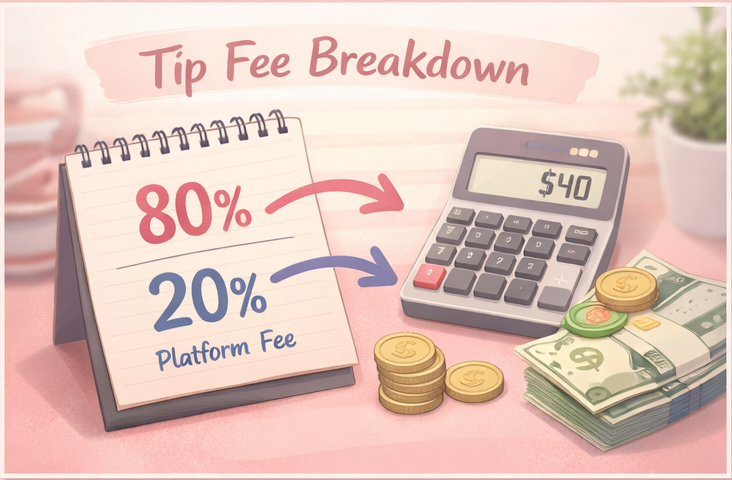
In this section, you’ll learn how OnlyFans tips are split and what you actually keep after the platform cut. Focus on your take-home amount (not the number the fan pays) so you can price tips, customs, and menus with confidence.
The basic split is 80/20
The common OnlyFans fee model is that the platform keeps 20% and the creator keeps 80%. A creator-focused fee guide says this flat 20% applies across subscriptions, tips, PPV content, direct messages, and live streams.
Source: https://www.creatorhero.com/blog/how-much-does-onlyfans-charge-creators
Tips are not treated as “free extra money”
A tip may feel more emotional or spontaneous than a subscription, but from a fee perspective it's still part of your platform earnings. That means the platform cut still factors in when you price customs, tip menus, and upsells.
Source: https://www.creatorhero.com/blog/how-much-does-onlyfans-charge-creators
Your dashboard total isn’t your final net income
The 80% you keep is your platform-side revenue before your personal taxes, and sometimes before outside costs like bank or currency-related fees. So the cleanest way to think about it is this: platform take-home is not the same as true net income.
Simple math for tips and subscriptions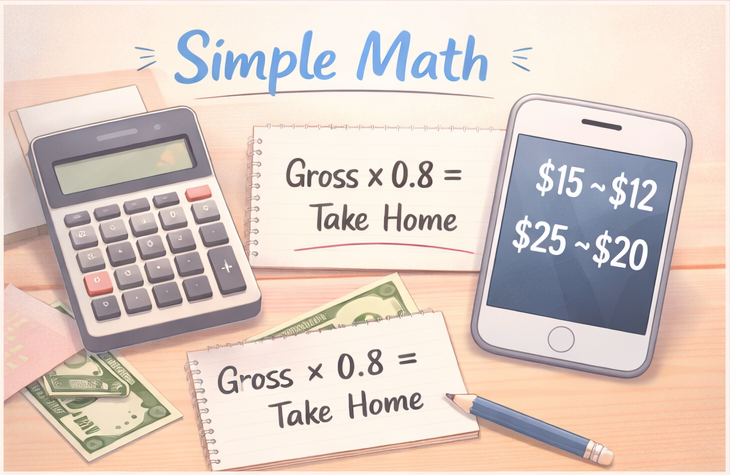
In this section, you’ll learn formulas for quickly calculating what you keep after the platform cut. These make pricing faster and help you avoid undercharging.
If you want to see how these same fee structures affect your take-home across subscriptions, PPV, and tips together, this complete breakdown of what OnlyFans takes from creators includes platform fee comparisons and real net income examples.
Tip math
A simple formula is:
Take-home = gross amount × 0.8
Examples:
- $5 tip → you keep about $4
- $10 tip → you keep about $8
- $25 tip → you keep about $20
- $50 tip → you keep about $40
- $100 tip → you keep about $80
If you aim to receive a specific amount after the platform cut, reverse the math:
Needed gross price = target take-home ÷ 0.8
So if you want to net $40, you would need to charge about $50.
Subscription math
When it comes to subscriptions, the same rule applies: there's a 20% platform cut, so creators keep 80%.
Examples:
- $9.99 subscription → you keep about $7.99
- $15 subscription → you keep about $12
- $25 subscription → you keep about $20
This is why a low monthly price can feel smaller than it looks, especially if the page also takes time to maintain.
Where creators lose profit even when the fee is simple
This section explains why profit can still feel low even with a simple 80/20 split—especially when low prices and high time costs stack up.
Low prices stack badly
A $5 tip sounds easy to ask for, but after the platform cut you keep about $4. If that tip comes with too much time, custom effort, or follow-up chatting, the emotional cost may be higher than the payout.
Cheap subscriptions can hide weak margins
A lower subscription price may help reduce friction, but it does not automatically create better income. If the sub is cheap and the fan never tips, buys PPV, or stays long, the revenue may stay thin even if your page is busy.
Too many weak buyers can feel expensive
The fee itself is flat, but your time is not. Ten low-spend fans who constantly message can cost more energy than two strong fans who tip well, buy extras, and stay longer.
Better profit usually comes from stronger fan value, not just more sales
This section connects the fee math to a smarter business model. It helps you think beyond “how much does OnlyFans take?” and toward “how do I keep more meaningful revenue?”
One of the most effective ways to increase what you earn per fan is through a well-structured tip menu — this tip menu strategy guide covers pricing tiers, upsell flow, and how to make tipping feel like a natural next step rather than a push.
Look at the real value, not the big numbers
The fee is fixed, so your real lever is fan quality. A creator with fewer but more engaged buyers may end up with better margins than someone doing endless low-ticket activity.
Human-in-the-loop AI support protects your profit and your time
To truly maximize that 80% take-home pay, you don't need thousands of low-spend subscribers—you need a smaller, highly engaged group of loyal fans. But managing endless messages to find those quality connections can quickly turn into an exhausting DM hell. That is where FanPort fits in naturally.
FanPort is an assist-tool, not a fully automated bot. It helps draft personalized responses and remembers fan details, lifting the heavy workload off your shoulders. This frees you up to personally review, tweak, and send the final messages, ensuring your VIPs and high-tippers always get your genuine attention. By focusing on direct, human relationships rather than pure volume, FanPort helps you earn high engagement and better profit with fewer followers—without burning out. Want to grow faster with this service? Click here.
Taxes and other deductions are a separate layer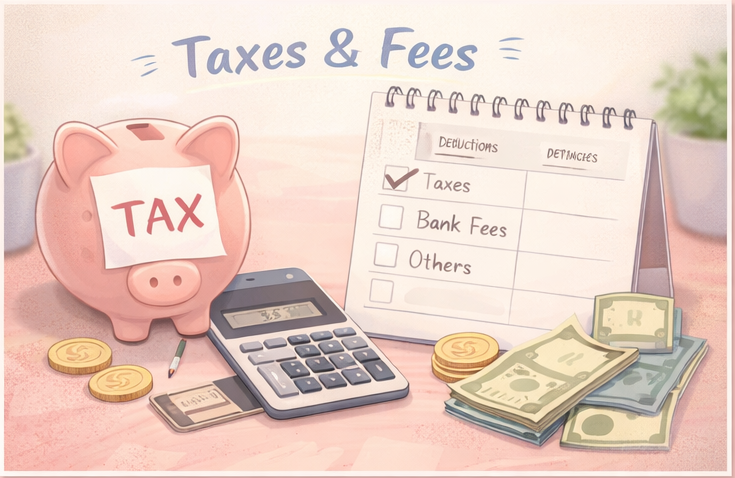
This section keeps the fee conversation honest. It helps you avoid mixing up platform commission with tax liability, because they're not the same thing.
The 20% platform fee is not your only reduction
Even if OnlyFans takes 20%, your real end-of-year take-home pay may be lower once taxes enter the picture. The IRS says self-employed individuals must usually file an annual return, may need to make estimated quarterly payments, and usually owe self-employment tax if net earnings from self-employment are $400 or more.
Track earnings and expenses separately
This is general information, not tax advice. A smart habit is to separate:
- gross fan spend
- platform-side take-home
- business expenses
- taxes set aside
That gives you a much clearer view of whether your pricing is actually working or not.
Use the 80/20 math to plan your real take-home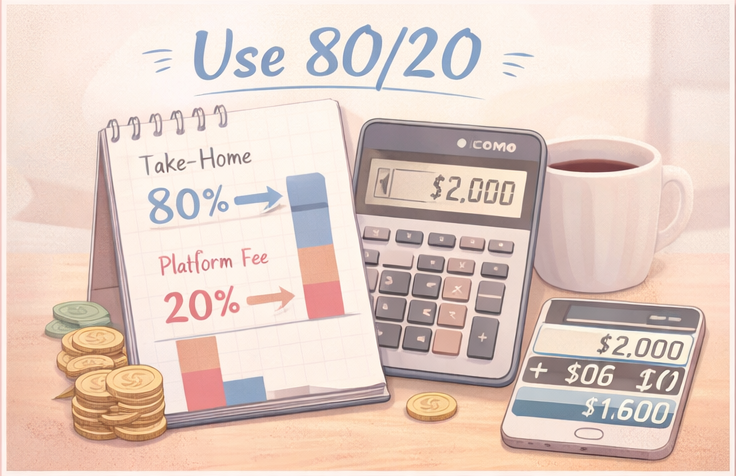
Yes, the 20% matters. Once you know the platform cut, make your take-home pay real: track expenses, set aside money for taxes, and price based on what you actually keep—not the gross amount on the fan’s screen.
FAQ
How much does OnlyFans take from tips?
Usually 20%, so the creator keeps about 80%.
How much does OnlyFans take from subscriptions?
The same basic split: 20% to the platform and about 80% to the creator.
If I get a $100 tip, how much do I keep?
About $80 before your own taxes or outside fees.
Is the 20% fee my final real profit cut?
No, it's the platform fee. Taxes and some outside costs may still lower your real net income.
Why do creators still feel underpaid if the split is simple?
Because weak pricing, high time cost, and low-value fan behavior can hurt margins even when the platform fee is easy to understand.
What improves profit more: lower prices or better fan relationships?
Often better fan relationships. Higher-value repeat buyers can matter more than large volumes of low-spend activity.